

Jelly vs leather, canvas & straw
Contents
Where jelly genuinely wins, and — because comparisons you can trust admit it — where it genuinely loses.
We've compared our two plastics against each other in TPU vs PVC. This is the bigger question: when does a jelly bag beat the classic materials — and when should you honestly buy the leather, the canvas or the straw instead?
The comparison table
| Jelly (TPU) | Leather | Canvas | Straw | Neoprene | |
|---|---|---|---|---|---|
| Rain | Beads off | Watermarks | Soaks through | Weakens | Damp, dries fast |
| Sand | Pours out | Abrades finish | Embeds in weave | Traps everywhere | Clings to texture |
| Weight | Light-medium | Heavy | Light | Very light | Very light |
| Care | Wipe clean | Condition, protect | Machine wash | Spot clean only | Machine wash |
| Ageing | Wipes back to its finish | Improves (patina) | Fades, frays | Sheds, snaps | Pills eventually |
| Formality | Casual→smart-casual | Casual→formal | Casual | Resort casual | Athleisure |
Where jelly honestly loses
- Formality ceiling. Opaque black jelly reaches smart-casual; it will never be the boardroom or black-tie bag. Leather owns that territory outright.
- Patina. Leather gets more beautiful with a decade of use; TPU's best case is looking much as it started. If ageing character is the point, buy leather.
- Haulage comfort. A packed canvas tote folds over the shoulder; a structured jelly tote doesn't. For the farmers' market mega-load, canvas wins.
Where jelly wins outright
Any day involving water, sand, sun cream or spills: the beach, the pool, the rainy commute, festivals, picnics, anywhere with a toddler. Zero maintenance is the quiet win: no conditioning, no waterproofing spray, no drying rack — a damp cloth and it's new again. And on looks, translucency is something no natural material can do at all — see the clear edit.
Why straw bags fall apart (and what helps)
We make jelly bags, not straw ones, but the care below is real anyway. Straw is summer's most romantic bag and its most fragile: dried plant fibre doing manual labour. It fails in five ways.
- Shedding. Dried fibres snap at flex points. Store it out of sun, stuffed with paper, and mist raffia lightly. You can slow it, not stop it.
- Snapped handles. The whole load runs through the weakest weave. Carry it by the body when it is full, and re-wrap a failing handle with leather cord early rather than after.
- Trapped sand. Every beach day leaves a layer in the weave that grinds the fibres from inside. Shake it hard and vacuum on low with a sock over the nozzle. Some of it lives there now.
- Snags. One loose end and one zip make a pulled loop you will see forever. Tuck it and dab with clear fabric glue from inside, and bind an unravelling rim with ribbon.
- Mould. Natural fibre, a damp swimsuit and a car boot make spots by morning. Never store it damp, and dry it briefly in the sun after a wet day (the one time sun helps).
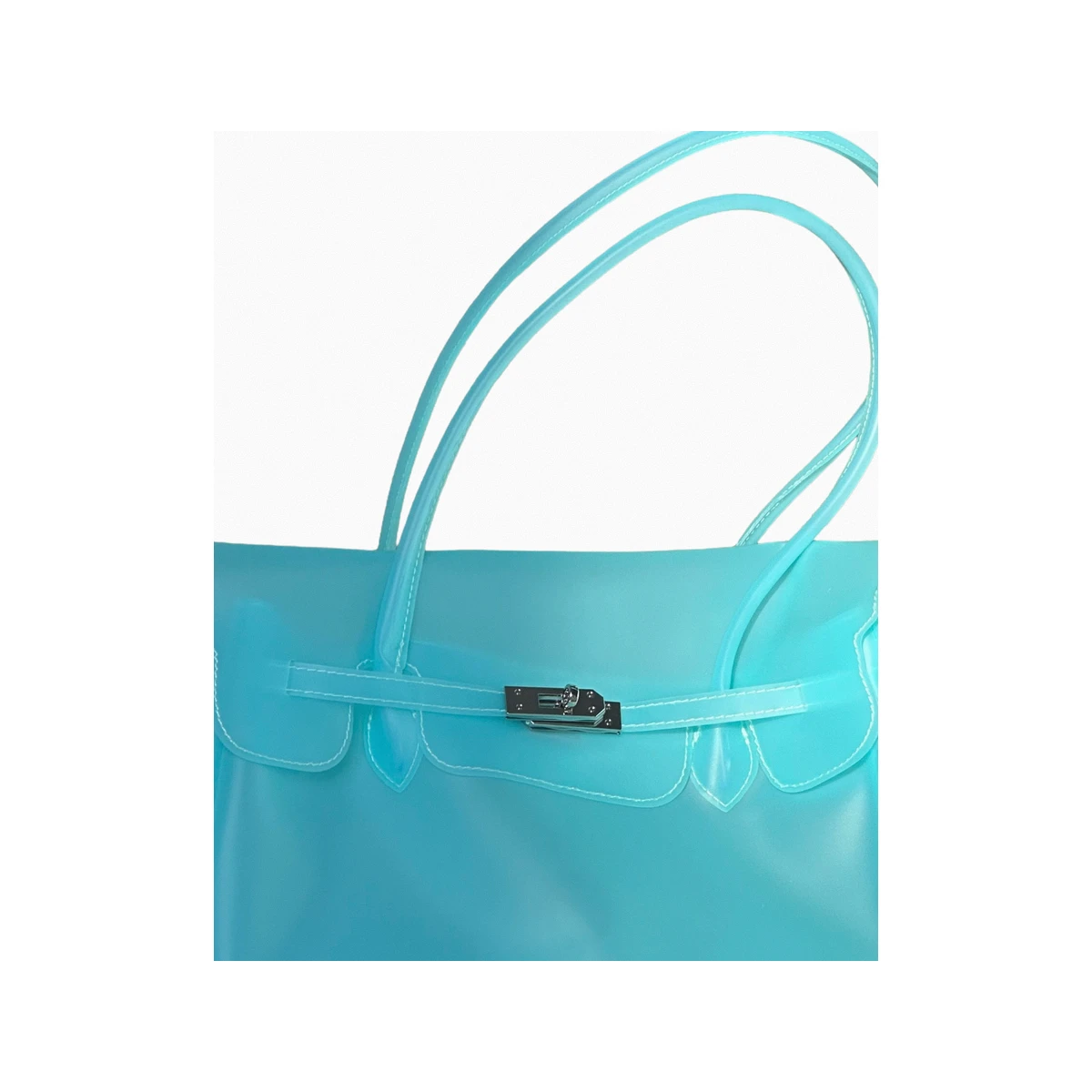
If you love straw for its look, keep it, care for it and give it the easy days. If you bought it for beach duty, you handed the hardest job to the most fragile material. Function wants the opposite: a smooth, non-absorbent shell where sand pours out and splashes bead off. Plenty of wardrobes keep both: straw for the aperitivo, jelly for the actual sand.
The honest conclusion
These materials mostly don't compete — they cover different days. The realistic wardrobe holds a leather bag for formality, and a jelly bag for every day the leather would suffer. If you're choosing your first jelly, the shape and size guide takes it from here.
Last reviewed: 2026-10-16
Common questions
Is a jelly bag better than a leather bag?
For different jobs. Leather wins on formality, patina and boardroom credibility — a jelly bag will never be a briefcase. Jelly (TPU) wins everywhere water, sand, sun cream or weight matter: it's lighter, wipe-clean, doesn't watermark in rain and needs zero conditioning. Most wardrobes are best with one of each; they don't actually compete for the same days.
What's the best material for a beach bag?
A non-absorbent smooth shell — TPU or similar. Canvas soaks and dries slowly, straw sheds and traps sand in the weave, leather shouldn't touch sand at all, and neoprene (excellent otherwise) still absorbs some water and holds sand in its texture. A smooth TPU shell lets sand pour out and splashes bead off.
Do jelly bags replace canvas totes?
For wet or messy duty, yes; for maximum-volume haulage, no. A canvas tote still wins on packable volume, shoulder comfort under heavy loads and machine-washability. The jelly tote wins the beach, the rain, the market and any day involving sun cream. Different tools.
Why is my straw bag shedding, and can it be repaired?
Shedding is dried fibres snapping. Natural straw and raffia lose moisture with sun and age, turn brittle and break at flex points. You can slow it by keeping the bag out of long direct sun, storing it stuffed with paper and misting raffia very lightly, but you can't stop it. Loose ends can be tucked and glued from inside, unravelling rims bound with ribbon, and a failing handle re-wrapped with leather cord. These are patch jobs, not restorations: if the base or handle anchors have gone, it is usually the end.